
The history of the WWE is a long and storied one. From its genesis as Capitol Wrestling Corporation by Jess McMahon (Great Grandaddy McMahon) and Toots Mondt (toughest man you’d ever meet named Toots) to its current position as the overbearing monolith that strikes fear in the hearts of indy promoters nationwide, the WWE has quite a story to tell.
Conveniently, WWE’s history has been subdivided into different eras to help you better understand it better. Or it’s arbitrary designation. Either way.
Anyway, one of these well defined eras is that of the New Generation, which stretched from 1993 until late 1997. The New Generation was a time where the WWF was going through a transition from the big, roided up monsters of the 80s to the smaller, better technically sound wrestlers of the early 90s. That and lawsuits. Transitions and lawsuits.

While the 80s WWF saw a boom in popularity thanks to the advent of Hulkamania, his mainstream exposure, and the monster of the week formula that worked for most of the decade, the New Generation of the 90s was the opposite of that.
Like in every way. Gone were the likes of Hulk Hogan, replaced by a small Canadian man who still dresses like a teenager.

Even main event wrestlers from the 80s like Macho Man Randy Savage were relegated to less than main event roles like announcing Monday Night RAW and putting over Crush.

By 1993, Earthquake, Akeem, and the Big Boss Man were all on their way to WCW and Hercules was taken out back and shot.
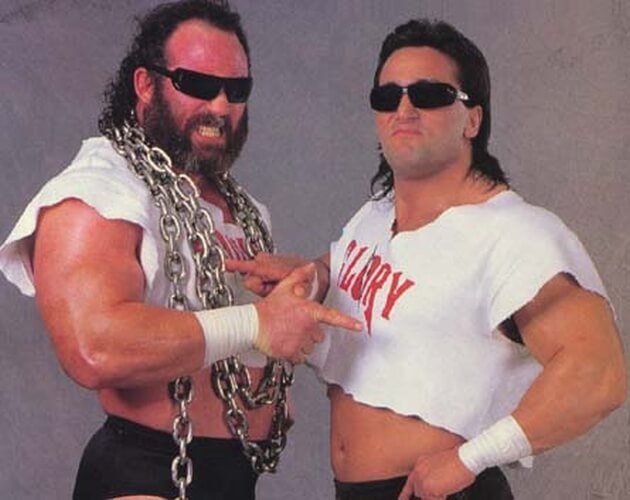
At the same time, the New Generation promised just that, something new. And while they delivered younger, smaller talents that could never been accused of doing steroids (I defy you to say Bret Hart has even heard the word in his entire life, let alone taken them), they kept on delivering the same old hokey, “kid friendly” gimmicks that fit right in alongside Reaganomics. Matter of fact, they actually got worse.
The Zeus-becoming-a-real-boy-and-challenging-Hulk-Hogan-in-real-life story not withstanding, most of what the WWF did in the 80s was actually pretty believable, but the New Generation….
The reasons for this transition were actually twofold. First, the WWF had become too reliant on Hulk Hogan for the previous 9 years, an act that had grown stale and led to Hogan to leaving the Federation to star in some piece of cinematic crap that makes The Room look like Masterpiece Theater. Coincidentally, or not, the second reason for this direction change is because of the steroid trial.
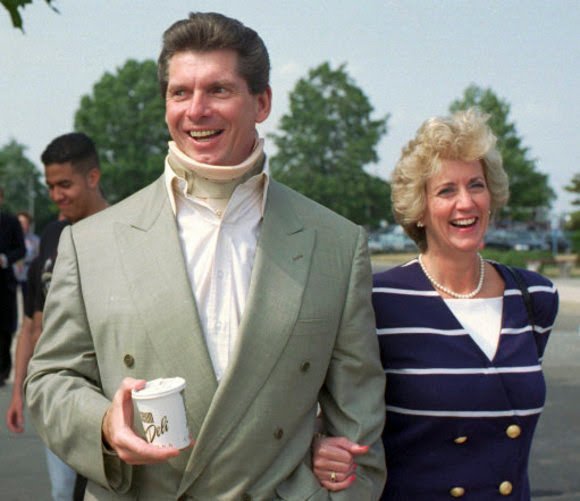
So, to kill two birds with one proverbial stone (Vince McMahon kills all literal birds with a handgun), the New Generation was born to build/focus on new stars while making sure those stars couldn’t be accused of taking steroids. So with all that in mind, that’s where the New Generation began.
The New Generation would be built on a combination of established and new talent, most of whom trended on the smaller side and weren’t in the 80s mold. To this end, Bret Hart, who started with the WWF in 1984 after the purchase of his father’s Stampede Wrestling promotion. Formerly a tag team competitor, in the early 90s, Hart went solo, leaving his partner and brother in law Jim Neidhart to team with his younger brother Owen and wear the most godawful ring gear of all time.

This is a similar story to his mid card counterpart, Shawn Michaels, the former Rocker who broke a real window in a fake barbershop with his partner’s face, then went on to simultaneously start his singles career and the term “be the Jannetty”.

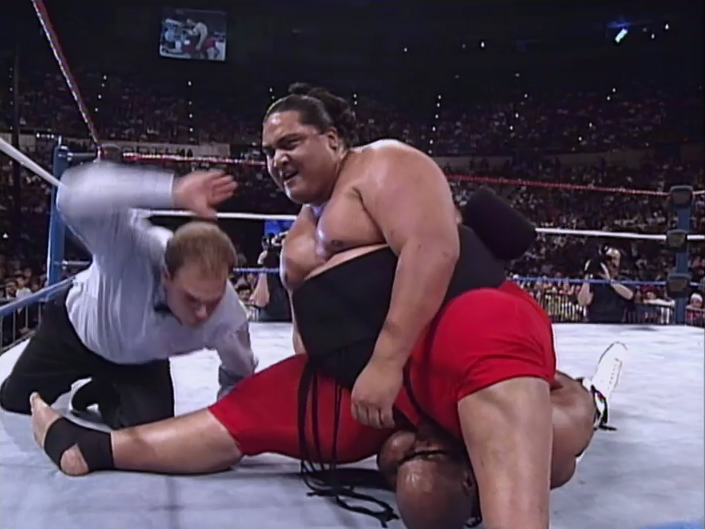
Then their was the main foil of Bret Hart, the 500+ Samoan pretending to be a Japanese sumo wrestler named Yokozuna, who was surprisingly agile despite his ass cheeks looking like two bean bag chairs.
There was also Razor Ramon, the former Diamond Studd, Starship Coyote, and…Big Scott Hall, because the 80s, now doing an admitted Scarface ripoff. Of course, since Vince McMahon doesn’t watch anything without a WWE logo on the left hand side of the screen, he’s still convinced it’s an original character that the WWE owns wholesale. Ramon would start as a heel in 1992, but would transition into “the Bad Guy”, a good guy, as part of the New Generation.

Along the way, the WWF picked up a key part of the New Generation in the form of a nearly 7 foot wrestler called Diesel. The former Vinnie Vegas, Master Blaster Steel, and f@#$ing Oz, the young Kevin Nash would fill the role of Shawn Michaels’ bodyguard. He would actually win the world title almost two years before Michaels and be the lowest drawing world champion of all time, but he got there first. That counts for something.

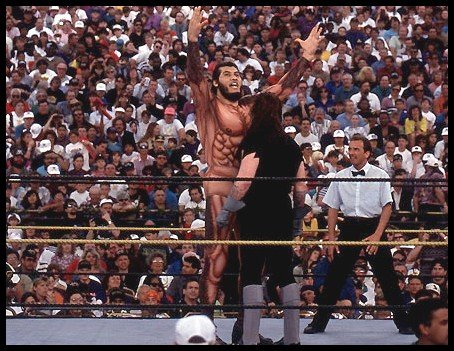
Meanwhile, The Undertaker, who debuted in 1990 would take a unique position as a performer who could be slotted in against main event talents when needed, but spent most of his time working against a seemingly nonstop conga line of the worst wrestlers the WWF could find and employ. From bringing back King Kong Bundy for some reason to hiring Giant Gonzalez to sleep walk his way through a WrestleMania match, the Undertaker never was missing for a truly terrible, but large, opponent.
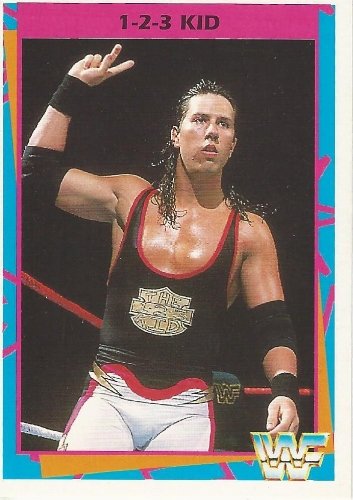
And that’s not to diminish the roles of others key to the era, from a literal babyfaced 1-2-3 Kid to “the King of Harts” Owen Hart, there was no shortage of talent during this time.
Remember when I said the WWF was moving toward smaller, better technically gifted wrestlers? Well, they also hired Lex Luger, which is so opposite of that, it’s like inviting the Joker to sit in on a Justice League meeting. That’s wrestling and comic books, a double nerd reference. I win. Anyway, Luger was a large bodybuilder, a product of Jim Crockett Promotions, and the man crush of many working in WCW all at the same time. The WWF brought him in as The Narcissist, a name that most of their audience couldn’t even spell, let alone define, so he was soon turned into the next Hulk Hogan because that’s what Vince McMahon wanted. He body slammed Yokozuna on board the USS Intrepid and went from a silver-bedecked ego with access to sparkler mirrors to a true American patriot defending us against…Japan…in 1993. Hmmm. Then, because Vince McMahon can’t see a Uncle Sam poster without getting an erection, he put Luger in the red, white, and blue, then sent him across the country in the Lex Express, a tour that was met with a resounding “meh” and (presumably) ended with Lex Luger beating Yokozuna at Summerslam…by count out, then celebrating anyway. The New Generation had some issues.
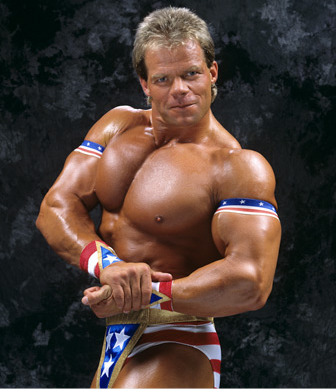
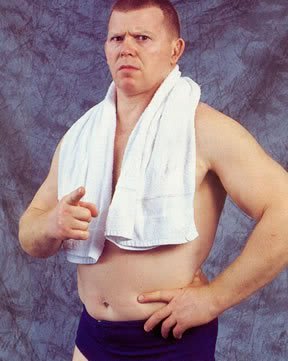
For a while, there was a conflict over the face of the New Generation as Vince McMahon wanted Lex Luger on top of the company while literally everyone else wanted that spot to go to Bret Hart. After a summer Lex’s bad tour, the two co-winning the Royal Rumble, and Lex having a match at WrestleMania X that was the height of “not terrible”, Vince McMahon finally gave up on Luger, put the belt on Bret Hart….then had Hart lose the belt to Bob Backlund. Yes, that Bob Backlund.
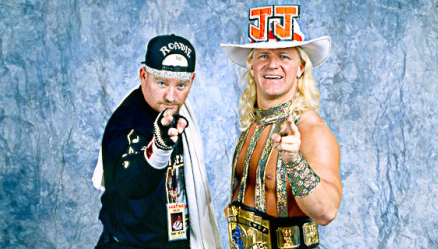
While these were the key figures in the New Generation, there were plenty of talents who came in and out of the company, holding certain positions, and sometimes leaving for greener pastures. And sometimes, they were just repackaged because what they had been doing was godawful. These mid card talents include Savio Vega, Mabel, evil teacher Dean Douglas, evil clown Doink, evil accountant IRS, evil dentist Isaac Yankem DDS, race car driver Bob “Spark Plug” Holly, garbage man Duke “the Dumpster” Droese, country singer Jeff Jarrett and his roadie….uh…the Roadie, and many more.
You’ll also notice another hallmark of the New Generation, the idea that careers were also gimmicks. While the 80s had their share of gimmicks, whether it was everyone having an animal some point (snakes, parrots, bulldogs, even a komodo dragon at one point), at least they weren’t just throwing a mechanic’s jumpsuit on a guy and calling him Jim Lugnuts. I mean, it makes as much sense as calling a grown man “Sparky”, but I digress. Later on, they’d hire hockey player The Goon, plumber TL Hopper, Man Mountain Rock, some kind of guitar playing guy, and a literal f$#@ing pirate, Jean Pierre Lafitte. I wish I was joking about this. Any of it.

Needless to say, ratings around this time weren’t great. They weren’t even good. Matter of fact, 1995 is so bad it’s considered a travesty deserving of a really bad telethon. And it didn’t get better. For all the talk of the New Generation, even to the point of mocking WCW for employing Hogan, Savage, and a menagerie of other 80s talent, for being “too old”, the New Generation simply didn’t draw. Not Diesel, not Bret Hart, not Bob “this time I’m crazy” Backlund, not even Shawn Michaels, who was a white meat babyface at a time where that was the worst thing to be. It’s not to say there weren’t talented performers there, it’s just that they weren’t giving people what they wanted. While WCW was certainly facing their own difficulties trying make the Hulk Hogan vs. Monster of the week seem fresh 10 years later, the New Generation wasn’t gaining any fans either. Simply put, the WWF was screwed.
1996 was more of the same, making Shawn Michaels the face of the New Generation, to the chagrin of a certain Sgt. Pepper jacket wearing Canadian. But, as I mentioned, Michaels didn’t draw as champion. They put the belt on Sid, back on Michaels, back on Sid, then the Undertaker, then back to Bret Hart. That was all going into late 1997.

And along the way, something else was growing beneath the surface, a particular bald Texan named Steve Austin. As Austin grew in popularity, going all the way back to mid 1996, the WWF product itself started to shift. The garbage men, hockey goons, and Jeff Jarrett were gone, or at least rendered irrelevant, which saw the rise of work shoot promos between Michaels and Hart, the rise of Austin, the reliance on believability and less on what profession they can make evil. They were this close to booking an evil character named Certified Pain Accountant. I just made that up, but I’m 80% sure I’m not far off.

Then something happened. In Montreal. Maybe you heard of it. With Bret Hart spitting and punching his way into WCW, Vince McMahon went from announcer who loved shouting “what a maneuver” to the devil in a $4,000 suit. And that’s where the New Generation died. While some will argue that the beginning of the famed Attitude Era was a backstage meeting in which McMahon said the company would be going a new direction, others argue that it was officially started when McMahon did his “cure for the common show” promo. Either way, the start of the Attitude Era is the definitive end of the New Generation, and not one minute too soon. Actually, a couple years too late.
So what’s to learn from the New Generation? Well, plenty. While there were some surprisingly great matches during this time, shows overall ranged from pretty OK to “why would you show me this?”. I mean, Lawrence Taylor main evented WrestleMania XI, for crying out loud! These were truly dark times. But what we ultimately learned was that the WWF doesn’t always have the answers, and a “new direction” doesn’t necessarily translate to success. They overcame this with the start of the Attitude Era, but not without the growing pains of “Make a Difference” Fatu and Rockabilly. Again, I wish I was making this up.




 DanFraley.com
Leave a comment